5 Disadvantages of vertical wind turbines (2026)
In short: Vertical axis wind turbines are less efficient than horizontal ones (Savonius approx. 10–17 %, Darrieus approx. 30–40 %, horizontal approx. 40–50 %), use weaker wind near the ground, face more vibration and, in the Darrieus design, often need a starting aid. Mast mounting, vibration dampers and a robust design largely compensate for these drawbacks.
Vertical axis wind turbines have 7 key advantages that make them perfect for small-scale power generation in unstable windy regions and urban areas. However, they have a few disadvantages as well. In fact, the design of this type of turbine remains popular as engineers come to tackle the challenges.
Through more than ten years of research and development since 2014, we have also come across and addressed certain problems and improvements of vertical axis wind turbines.
The challenges brought by disadvantages of vertical axis wind turbines
1. Less Rotation Efficiency
Vertical axis wind turbines often have less rotation efficiency. This is part of the reason why vertical axis wind turbines have lower efficiency.
Due to the rotor design, not all the blades on the vertical axis rotor receive incoming wind at the same time. In fact, only the wind-facing blades are driven by the wind to turn while the others are simply following along. During rotation, vertical axis rotors are also faced with more drag— or aerodynamic resistance— on the blades.
This is especially shown on Savonius wind turbines because they have wider blade surfaces.
2. Lower Available Wind Speed
Since vertical axis wind turbines are typically installed on ground level, they do not harness higher wind speeds often found at higher levels. Consequently, less wind energy is available for ground-level vertical axis wind turbines. A common solution to this is to install the turbine on the rooftop of a building.
To address this problem, we have improved the rotor design so that it can be mounted on top of a mast. The rotor and the mast combined tower our vertical axis wind turbine to 10 meter high, with the generator and power electronics located at the 4-meter height.
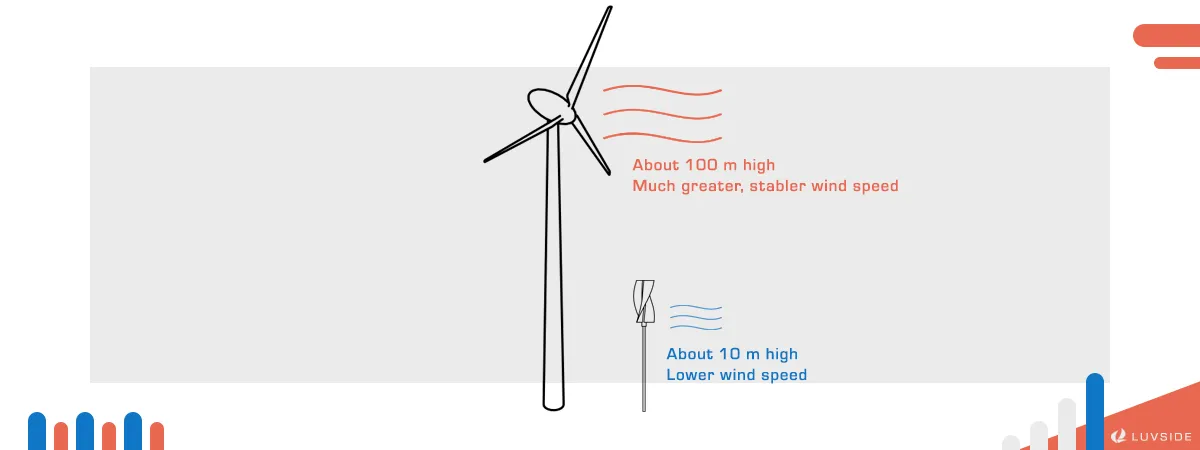
Compared to horizontal axis wind turbines, vertical axis wind turbines operate with lower wind speed. Wind Turbine Icons created by Lluisa Iborra from the Noun Project.
3. Component Wear-down
Often placed on ground level and populated environments, vertical axis wind turbines face more turbulence and issues of vibrations. When in operation, not only do the blades need to withstand more force, the bearing between the rotor and the mast also needs to endure higher pressure. In earlier models, it was more likely for the blades to bend or crack. For others, this can result in more maintenance and therefore more cost.
To strengthen our own turbines, we have taken wear-down calculations into consideration for design and manufacture. The LuvSide vertical axis wind turbines are now robust enough to stand wind speed equivalent to a strong tropical storm.
4. Less Efficiency
Vertical axis wind turbines are known to have less efficiency compared to horizontal axis wind turbines. This is mainly due to the nature of their design and operational characteristics.
On average, the efficiency of a horizontal axis wind turbine lays between 40 to 50 %, meaning the turbine is able to convert 40% to 50 % of the kinetic energy it receives into actual electrical power. On the other hand, a Savonius vertical axis wind turbine has an average efficiency of 10 to 17 %, while the Darrieus vertical axis wind turbine reaches 30 to 40 %.
Even so, given the suitable environment, a Savonius wind turbine can still produce enough power to support annual consumption of a normal two-person household.
5. Self-Starting Mechanism
While horizontal axis wind turbines and Savonius wind turbines start turning automatically once receiving wind, Darrieus wind turbines often rely on a starting mechanism. This is because the wing design of Darrieus wind turbines does not always guide the wind to form enough torque for rotation. At the moment, this is still a challenge that many, including us, are trying to tackle.
Discovering potentials of alternative power generation
Despite these disadvantages, we believe vertical axis wind turbines are still worth investing in and developing. It is certain that this type of wind turbine has the potential to not only establish its niche market, but also provides alternatives to horizontal axis models where they do not fit.
The 5 disadvantages and their solutions at a glance
| Disadvantage | Cause | LuvSide solution |
|---|---|---|
| Less rotation efficiency | only the wind-facing blades drive the rotor | slats close gaps in the wind window and increase torque |
| Lower available wind speed | installation close to the ground | mounting on a mast (total height up to 10 m) or roof |
| Component wear | turbulence and vibration | wear calculations in the design, vibration damper on the LS Helix 3.0, survival wind speed 180 km/h |
| Lower efficiency | rotor design | used where turbulence, noise and space matter; combined with PV and storage |
| Starting aid (Darrieus) | aerofoil produces little torque at standstill | Savonius principle is self-starting, LuvSide models from 3–4 m/s |
VAWTs in commercial use
The disadvantages decide where a vertical axis wind turbine makes sense – not whether. For businesses, municipalities and infrastructure operators it pays off where a horizontal turbine does not fit: on office roofs, between buildings, at ports or at off-grid sites such as telecom masts. LuvSide builds the LS Double Helix 0.5 Marina, the LS Double Helix 1.0 and the roof-ready LS Helix 3.0 for these applications. If maximum yield on open land is the priority, the horizontal LS HuraKan 6.0 is the better choice.
Compare rotor types and models on our page vertical axis wind turbine, and read about the upsides in 7 advantages of vertical wind turbines.
FAQ: disadvantages of vertical axis wind turbines
Why are vertical axis wind turbines less efficient?
On a vertical rotor only the blades facing the wind drive it, while the others move against the wind. Typical efficiencies are approx. 10–17 % (Savonius) and approx. 30–40 % (Darrieus), compared with approx. 40–50 % for horizontal axis turbines.
Is a vertical axis wind turbine worth it despite the disadvantages?
Yes, at the right site: where the wind is gusty, noise and shadow flicker must be avoided or space is limited. An average wind speed of about 4 m/s or more at hub height is decisive.
How high should a vertical wind turbine be mounted?
As high and as unobstructed as possible, because wind near the ground is weaker and more turbulent. LuvSide mounts its rotors on masts with a total height of up to 10 metres or on suitable roofs.
Do vertical axis wind turbines need a starting aid?
Usually only the Darrieus design does. Savonius and helical rotors such as LuvSide’s start by themselves.
Related Content
This article examines how combining wind turbines with solar panels creates cost synergies across fuel savings, maintenance reduction, optimized energy storage, and extended equipment lifespans—with...
This guide covers the maintenance strategies, component priorities, and technologies that keep remote wind systems running reliably despite distance and harsh conditions. You’ll learn how...
Diesel generator or wind solar hybrid system with storage? This comparison covers power output, fuel and maintenance costs, levelised cost of energy and emissions –...
A step-by-step guide to choosing the right small wind turbine for your farm – from load profile and wind assessment to turbine type, sizing, 2026...
Industrial energy demands are driving unprecedented growth in hybrid renewable systems, with hybrid wind-solar-storage solutions representing the most cost-effective path to energy independence for large-scale...
Telecom towers need power around the clock – often far from the grid. How hybrid wind-solar systems with battery storage replace diesel generators, meet SLA...
How small wind turbines combined with solar help farms cut energy costs, gain independence and keep power flowing at night and in winter – updated...
Wind turbines are subject to strict regulations in the EU to ensure their safe operation even during power outages. An uninterruptible power supply (UPS) is...
The South African mobile phone industry is on the brink of a radical transformation when it comes to powering its cell towers. LuvSide’s LS Helix...

A functioning and nationwide mobile network is the backbone of modern communication in South Africa. To ensure uninterrupted connection, mobile phone masts must be continuously...
The energy transition has already reached urban areas. In addition to solar modules on roofs and green façades, small wind turbines are increasingly being considered...
There are several types of generators that can be coupled to small wind turbines: most importantly DC or AC types and synchronous or asynchronous that...
Wind turbines have been assisting mankind to convert the energy contained in wind into electricity for the last 50 years. This has been possible due...
How does a business or remote site become energy independent? The basics of off grid power, the right energy sources and 8 proven strategies –...
When it comes to wind turbines, people expect them to always be turning. In reality, though, that isn’t always the case. Since wind turbines generate...
When evaluating the power generation performance of a wind turbine at a certain location, there are a few measurements that are commonly taken into consideration....
In short: Vertical axis wind turbines capture wind from any direction without a yaw system, work in turbulent wind, run quietly, cause no shadow flicker...
Horizontal axis wind turbines dominate wind farms, vertical axis wind turbines shine on roofs and in turbulent urban wind. This comparison explains how both types...
Since centuries ago, humans have learned to utilize wind power for activities ranging from everyday tasks like grinding grains to long-distance traveling such as sailing....