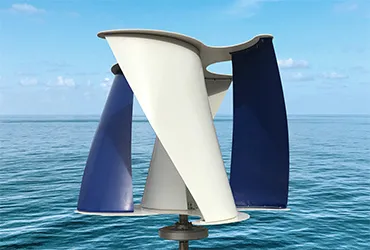
LS Double Helix 0.5 Marina
Vertical wind turbine
- Nominal power: 500 W at 16 m/s
- Annual yield: approx. 300 kWh
- Diameter: 1.4 m
- Height: 1.0 m


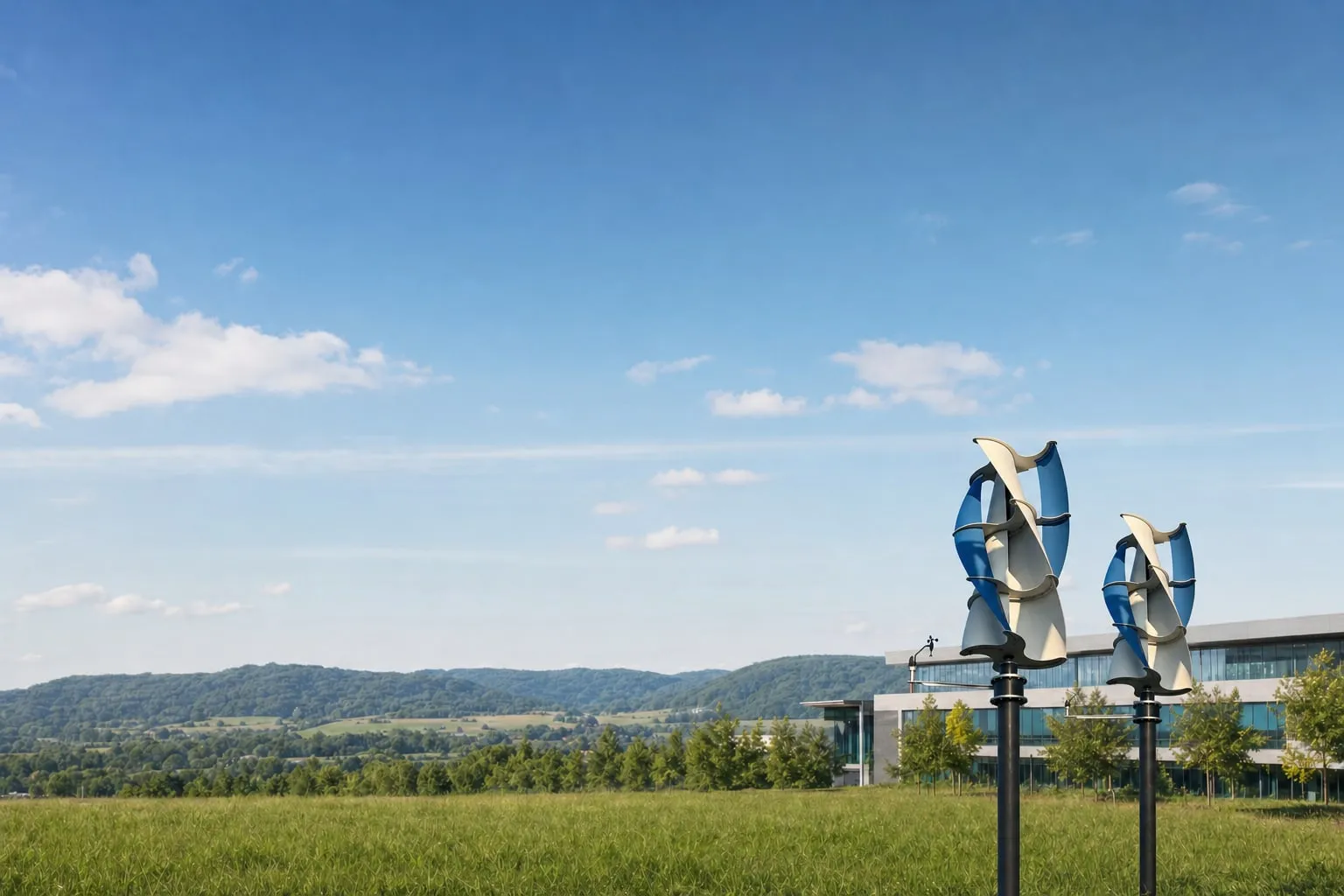
A vertical axis wind turbine (VAWT) is a wind turbine whose rotor spins around a vertical shaft. It captures wind from any direction without a yaw system, copes with gusty, turbulent wind and runs very quietly. That makes it a good fit for rooftops, company premises, ports and infrastructure. LuvSide builds vertical wind turbines from 0.5 to 3 kW.
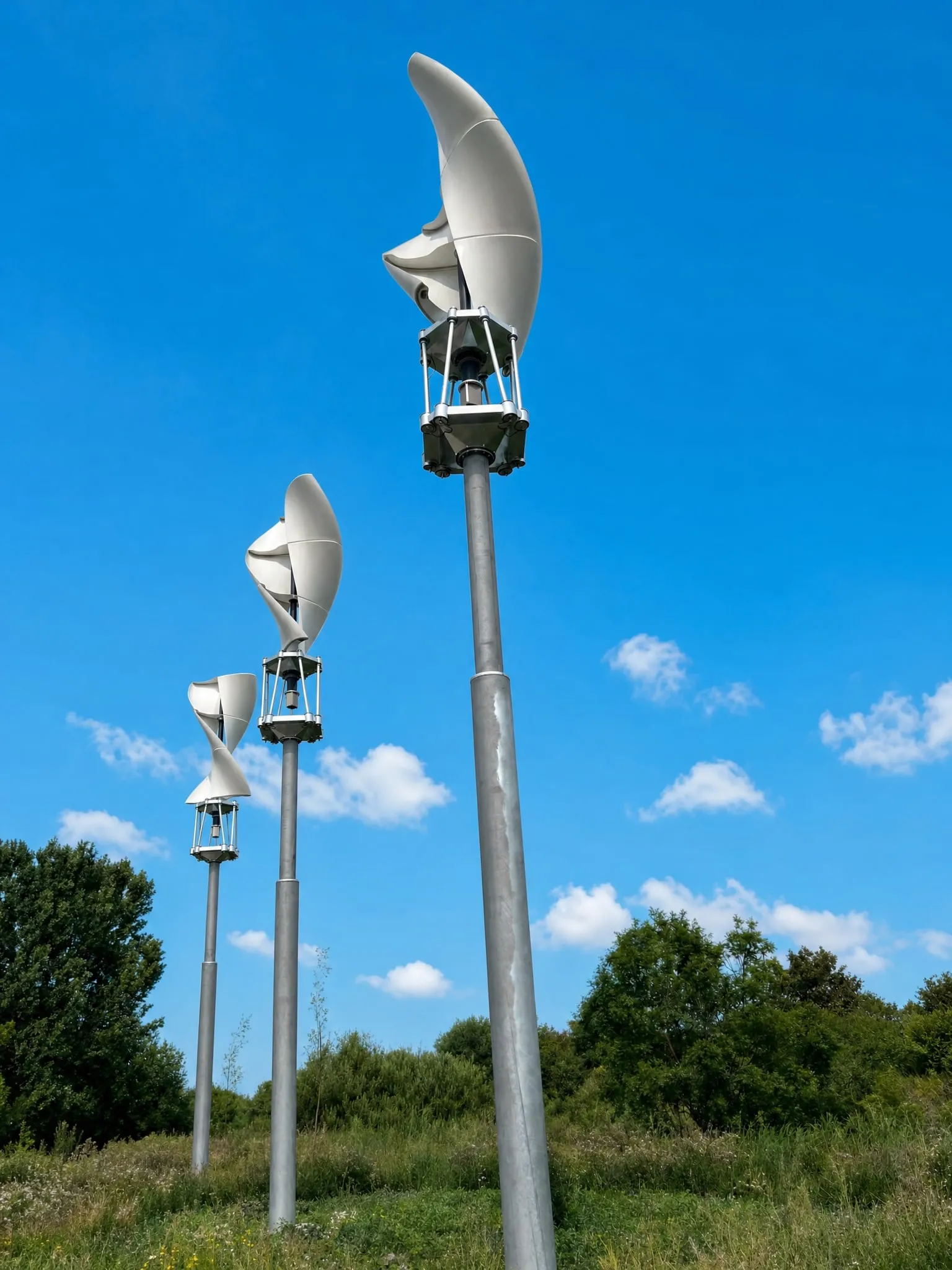
As with any wind turbine, the airflow turns the rotor and the generator converts the mechanical energy into electricity. The difference is the axis: in a vertical axis wind turbine the shaft stands upright and the blades rotate around it like a carousel. No yaw system is needed, and the generator and electronics sit close to the ground or at the top of the mast.
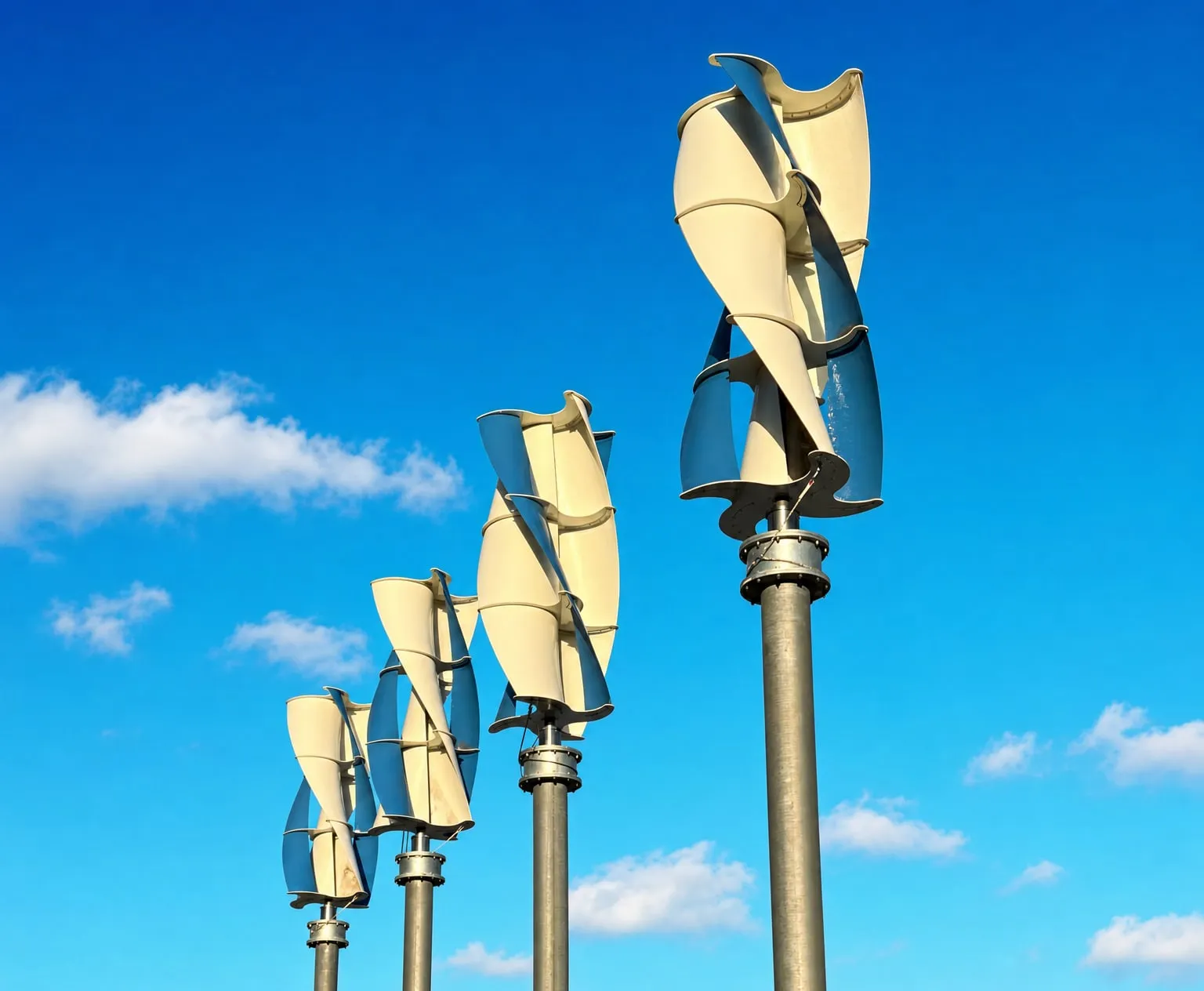
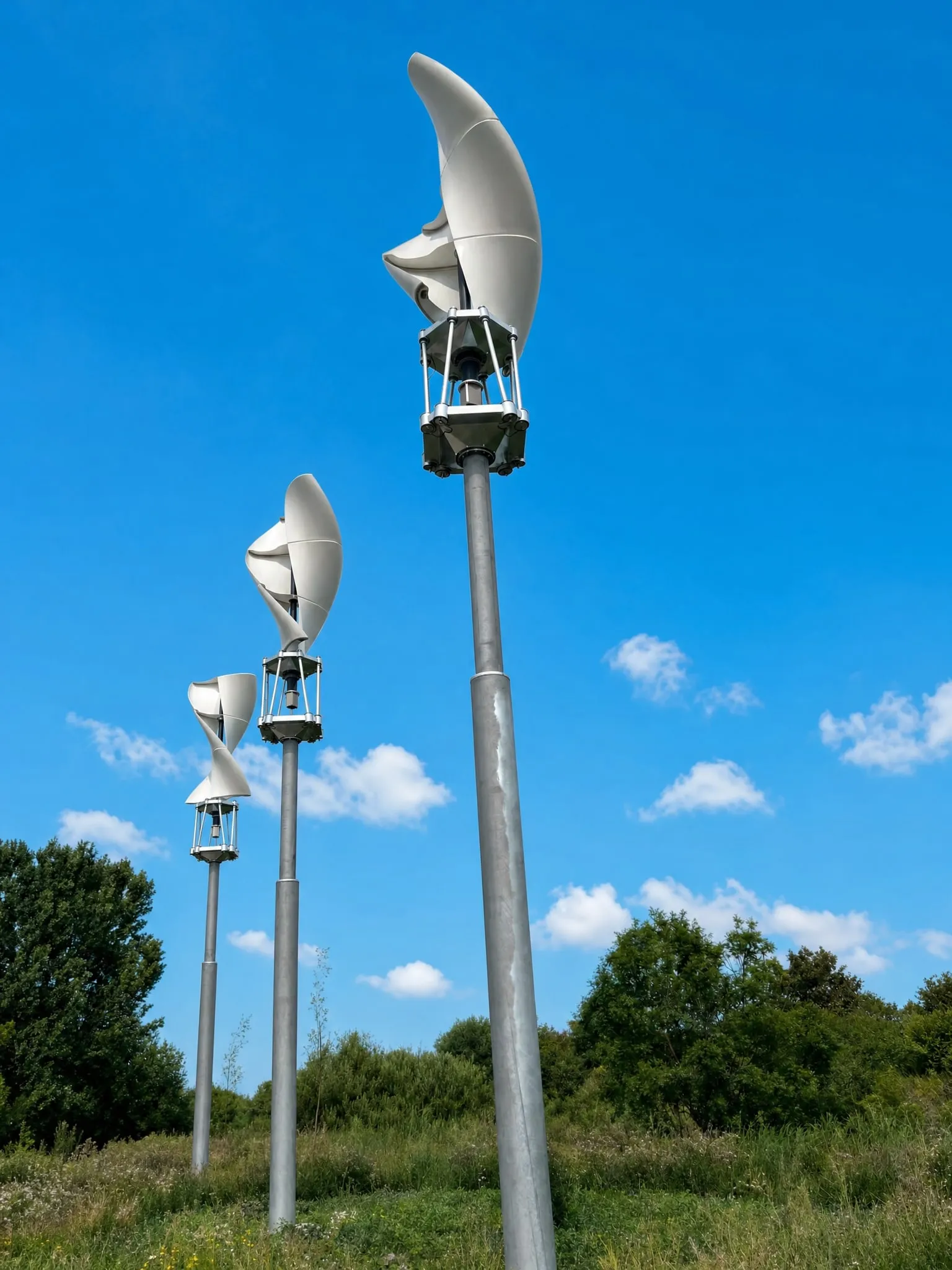
There are two working principles: the drag-type rotor (Savonius), driven by wind pressure on the blade surfaces, and the lift-type rotor (Darrieus), whose aerofoil blades generate lift like a wing. If the blades are twisted around the shaft, the result is a helical rotor.
LuvSide develops the Savonius principle further: two additional slats complement the two main blades, closing gaps in the wind window and increasing torque. Thanks to the helix structure, the wind always hits the same surface, no matter which direction it comes from.
In detail: how do vertical axis wind turbines work?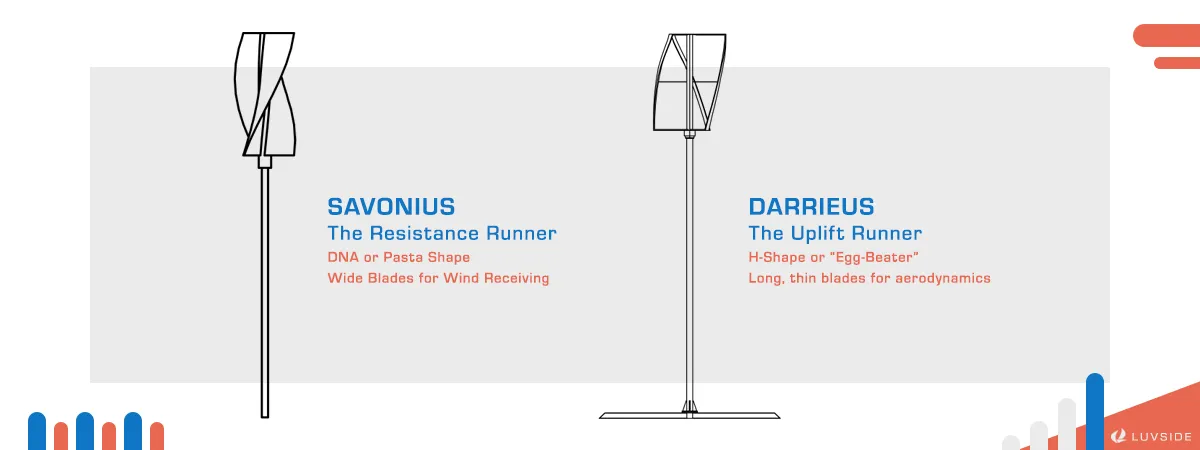
| Criterion | Savonius (drag type) | Darrieus / H-rotor (lift type) | Helical rotor (e.g. LuvSide) |
|---|---|---|---|
| Working principle | wind pressure on scoop-shaped blades | lift on aerofoil-shaped blades | Savonius principle with helically twisted blades and slats |
| Rotor shape | S-shaped half shells | curved “egg-beater” blades or straight blades in an H shape | blades wind around the shaft like a strand |
| Start-up | self-starting, even in light wind | usually needs a starting aid | self-starting – LuvSide from 3–4 m/s |
| Rotor speed | no faster than the wind | blades move several times faster than the wind | slow: 100–140 rpm (LS Helix 3.0) |
| Typical efficiency | approx. 10–17 % | approx. 30–40 % | Savonius type; slats and helix increase torque |
| Torque | pulses with each revolution | pulses with each revolution | smooth, as the wind always hits the same surface |
| Noise | very quiet | quiet, depends on tip speed | very quiet |
| Turbulent wind | insensitive | more sensitive | insensitive |
| Typical use | micro systems, ventilators, off-grid | larger VAWT projects, research | roof, mast, harbour, company premises |
Efficiency: typical literature values, as explained in our article disadvantages of vertical wind turbines. The yield of an actual turbine depends more on the site than on the rotor type.
Vertical turbines produce less electricity per square metre of rotor area than large horizontal turbines. Their strength lies where horizontal turbines reach their limits: on rooftops, between buildings and wherever noise, shadow and appearance matter.
Wind from every direction, no yaw system. Gusts and changing directions on rooftops and company sites are used instead of chased.

Slow rotation, no blade swish. The LS Helix 3.0 is decoupled by a vibration damper and transmits no structure-borne noise into the building.
The compact, closed rotor is easy to see. On the LS Double Helix 0.5 Marina the blade tips move at only about half the wind speed.

The blades sit close to the shaft. There is no moving shadow, and the turbine blends into commercial and urban surroundings.

Survival wind speed of 50 m/s (180 km/h) according to the datasheet. In storms, a dump load or overload clutch protects generator and electronics.

The rotor houses all key components. Mounting on a mast or roof, maintenance without climbing a tall tower.
Vertical axis wind turbines are less efficient than horizontal ones and need a site with enough wind – close to the ground and in the lee of buildings the yield drops considerably. For maximum kilowatt-hours on open land, a horizontal turbine such as the LS HuraKan 8.0 is often the better choice.
7 advantages of vertical wind turbines 5 disadvantages – and how we solve them
| Criterion | Vertical (VAWT) | Horizontal (HAWT) |
|---|---|---|
| Wind direction | 360° – no yaw system needed | aligned by tail vane or motor |
| Turbulent wind | very well suited | better on open sites |
| Noise & shadow | almost silent, no shadow flicker | low, depends on size and site |
| Efficiency | lower, but steady | higher with free-flowing wind |
| Typical installation | roof, mast, harbour, company premises | open land, farm, industrial estate |
| LuvSide models | LS Double Helix 0.5 / 1.0, LS Helix 3.0 | LS HuraKan 8.0, WindSun |
All turbine types, industries and a yield calculator are on our page small wind turbines for business.
Three vertical turbines, designed and built in Ottobrunn near Munich – from the off-grid charger for ports to the 3 kW turbine suitable for rooftops.
| Model | Rated power | Start-up from | Diameter × height | Annual yield approx. | Use |
|---|---|---|---|---|---|
| LS Double Helix 0.5 Marina | 0.5 kW | 3 m/s | 1.4 × 1.0 m | 300 kWh | ports, boats, flat roofs; charges 48 V batteries |
| LS Double Helix 1.0 | 1.0 kW | 3 m/s | 1.4 × 3.0 m | 1,000 kWh | off-grid, 24/48 V; mast or sturdy roof |
| LS Helix 3.0 | 3.0 kW (max. 5.0 kW) | 4 m/s | 2.2 × 4.0 m | 2,500 kWh | roof with vibration damper, mast, company premises |
Annual yields as stated by LuvSide; they depend on the wind conditions at the site.
Vertical wind turbine
Vertical wind turbine
Vertical wind turbine
For higher outputs we combine several turbines: three LS Helix 3.0 together reach 9 kW rated power, just as two turbines work together on the roof of Kiel University of Applied Sciences. We plan the layout for your site.
Since May 2023, two LS Helix 3.0 have been running on the roof of Kiel University of Applied Sciences. The electricity is used directly in the building, and the turbines also serve teaching. Thanks to their low noise, they can be placed closer to surrounding buildings than horizontal turbines.
At the V&A Waterfront in Cape Town, LS Double Helix 1.0 turbines generate electricity for a commercial and harbour area – right between shops, restaurants and visitors.
Yes. Vertical axis wind turbines reliably generate electricity when the site has enough wind. They are less efficient than large horizontal turbines but keep working in turbulent wind from changing directions. LuvSide turbines have been in operation at ports, on rooftops and at telecom masts for years.
That depends on size and wind. According to LuvSide, its models deliver around 300 kWh (LS Double Helix 0.5 Marina), 1,000 kWh (LS Double Helix 1.0) and 2,500 kWh (LS Helix 3.0) per year. Our yield calculator gives an estimate for your wind speed.
A Savonius rotor is a drag-type rotor: the wind pushes on scoop-shaped blades, the rotor turns no faster than the wind and starts by itself. A Darrieus rotor is a lift-type rotor: its aerofoils generate lift, the blades move faster than the wind, but it usually needs a starting aid.
Not in general. Horizontal turbines extract more energy from the wind on open land. Vertical turbines have the edge where wind is gusty, where it has to be quiet and where space is limited – on rooftops or company premises, for example. LuvSide builds both and recommends the right one after a site assessment.
Yes, after checking the structure. The LS Helix 3.0 is decoupled by a vibration damper so no structure-borne noise is transmitted into the building. The LS Double Helix 1.0 weighs 470 kg and can be mounted on a sturdy roof.
Yes, very. The rotor turns slowly (100–140 rpm on the LS Helix 3.0) and there is no typical blade swish, which is why vertical turbines also suit sites close to buildings.
The compact, closed rotor turns slowly and is easy for birds and bats to see. On the LS Double Helix 0.5 Marina, the outermost points of the rotor move at only about half the wind speed.
LuvSide achieves higher outputs by combining several turbines: three LS Helix 3.0 together reach 9 kW rated power. The layout is planned for each site.
The price depends on the model, mast or roof mounting, grid or battery connection and installation effort. LuvSide quotes prices on request after a site assessment. Our page wind turbine cost gives an overview of the cost components.
A vertical axis wind turbine (VAWT) has a rotor that spins around a vertical shaft. Here is how Savonius, Darrieus and helical rotors work and where VAWTs make sense.
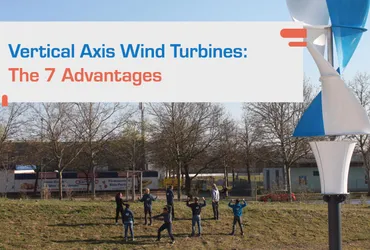
More infoWind from any direction, closer spacing, quiet operation: these 7 advantages make vertical axis wind turbines attractive for rooftops, cities and company premises.
More infoLower efficiency, weaker wind near the ground, wear: the 5 disadvantages of vertical axis wind turbines and how LuvSide addresses them in its designs.
More infoTell us about your project – roof, company premises, harbour or mast. We check wind conditions, structure and permitting and recommend the right turbine.
Private customer? Our distribution partners will be happy to advise you locally.