
Application & Operation, WindyBlog
Small Wind Turbine Siting & Permit Guide
Where a small wind turbine stands determines how much power it produces – and whether you may build it at all. Check three things: how much wind reaches the site, whether the location suits foundation, installation and connection, and which regulations apply where you are.
Selecting the most suitable location for a small wind turbine isn’t only about picking where the most wind goes. The turbine needs enough space for installation, maintenance and operation, but should not be too far from the grid or the consumer. This guide combines the three essential steps for evaluating a potential or chosen site for your business, farm or municipality.
The Assessment & Planning Checklist for Small Vertical Axis Wind Turbine Installation contains every question in this guide, ready to print and tick off – a good preparation for talking to us or to your local authority.
Contents
- Step 1: Know your wind conditions
- Step 2: Evaluate your location
- Step 3: Know the regulations and permits
- FAQ
Step 1: Know your wind conditions
A wind turbine’s performance depends heavily on the wind it receives. When we select a location for a small wind turbine, we always look for the best wind resource and a high capacity factor. The rule is simple: the higher the wind speed, the more power generated; the steadier the wind, the smoother the turbine runs. Because power rises with the cube of wind speed, doubling the wind speed theoretically yields eight times the power.
Local wind data helps you estimate the potential output, the reliability of supply and the financial return. If you haven’t chosen a turbine yet, it also helps you pick the most suitable model.
What wind data do you need?
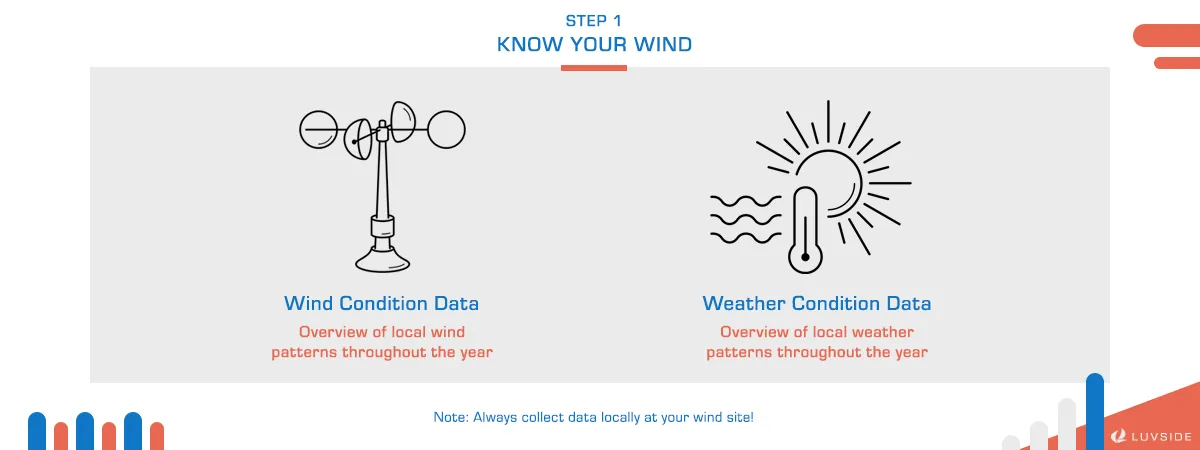
1. Long-term wind analysis. Collect wind data at the planned site continuously for at least three months, ideally a full year, for example with an anemometer. Mount it at the height of the future rotor – often 10 metres or more for small wind turbines – to capture prevailing wind speed, direction and consistency.
2. Weather overview. Even though small wind turbines are weatherproof, regional weather data shows seasonal changes, storm frequency and temperature ranges that your engineers need for structural design.
As a rule of thumb, the average wind speed at hub height should be at least about 4 m/s for economic operation.
Always measure on site
National or regional wind maps give a first indication but cannot capture local wind speed distribution, direction or turbulence caused by terrain, trees and buildings. For reliable data, measure at the site itself at the appropriate height.
Step 2: Evaluate your location
Once you know the wind resource, evaluate the physical space where the turbine will stand. This clarifies the realistic construction requirements. If the site is not suitable yet, consult architects or structural engineers about adapting the area or relocating the turbine.
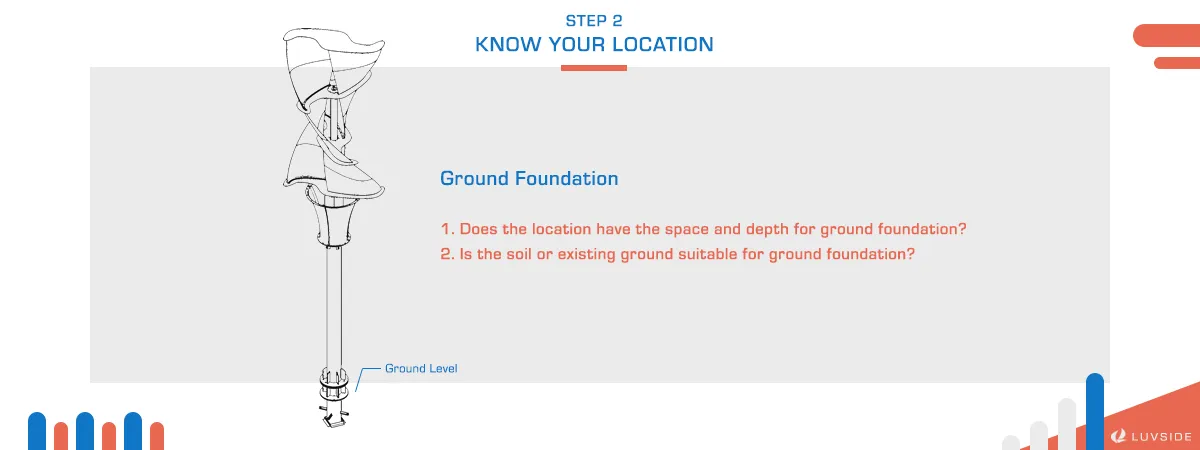
1. Ground foundation
The turbine needs a foundation designed for the loads involved, so the mast can safely transfer wind forces into the ground. Have a construction professional check whether the ground at your chosen spot is suitable.
2. Surrounding space
The surrounding landscape largely determines how much wind reaches the turbine. Hills and forests affect wind speed; single trees, buildings and other structures within about 200 metres can block the wind and create turbulence. Vertical axis wind turbines such as LuvSide’s models operate smoothly in turbulent wind. If you plan a horizontal turbine near obstacles, we recommend an aerodynamic assessment.
3. Wiring distance
Whether the turbine connects to the grid or to a battery, consider the cable run to the consumer. The longer the cable, the higher the losses. Have an electrician estimate cable size and losses in advance.
Rooftop installation
Installing a small wind turbine on a roof is possible but requires a stricter assessment. The building structure must permanently withstand the weight, wind forces, torque and vibration. Every building needs individual planning. The LS Helix 3.0 is decoupled by a vibration damper and is therefore suitable for rooftop installation.
Step 3: Know the regulations and permits
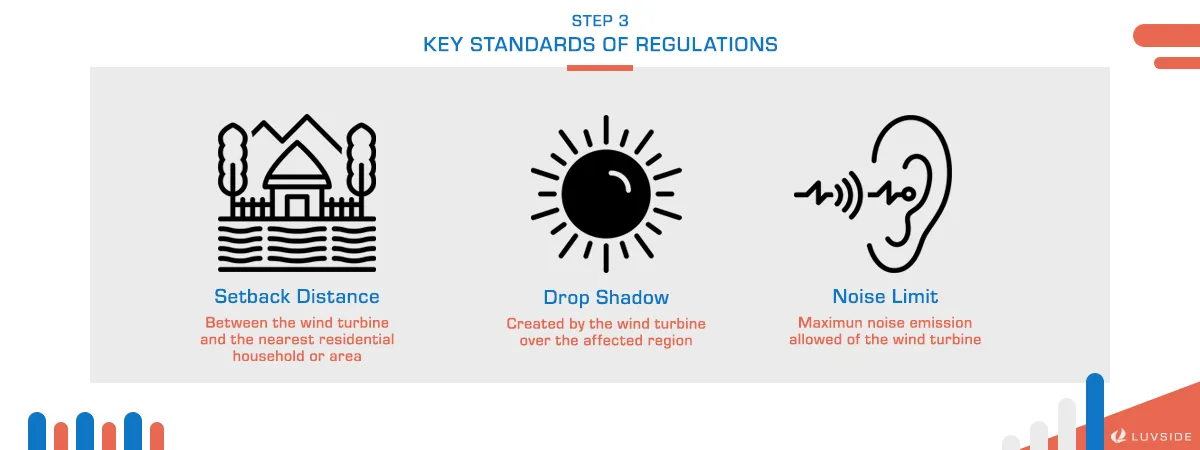
With wind and location assessed, the formal part follows. Small wind turbines are subject to regulations that may restrict construction or require approval. Typical requirements cover setback distances to homes and boundaries, noise limits and shadow flicker.
Germany
In Germany each federal state decides in its building code whether a small wind turbine needs a building permit. As of 2026, in simplified terms:
| Situation | Typical rule |
|---|---|
| Turbines up to 10 m high | permit-free in many states, sometimes with rotor size limits and not in purely residential zones |
| Turbines up to 15 m high | permit-free in some states, e.g. Bavaria and Lower Saxony |
| Taller turbines or special cases | building permit, sometimes a simplified procedure |
| Turbines over 50 m total height | permit under the Federal Immission Control Act |
Even a permit-free turbine must comply with setback, noise, nature and heritage rules. Every generating plant must also be registered with the grid operator and in the national market master data register. Details per state are published by the Bundesverband Kleinwindanlagen.
Europe
There are no uniform European rules. Some countries only issue recommendations, others have mandatory requirements:
- Recommendations only: setback, noise and shadow flicker are recommended but not enforced – for example in the United Kingdom, Ireland, Spain, Italy and Sweden.
- Noise requirements only: binding noise limits, recommendations for the rest – for example in Portugal and the Netherlands.
- All requirements: mandatory rules for setback, noise and shadow flicker – for example in Denmark and France.
Worldwide
Local legal experts, building inspectors and authorities know the rules best. Laws change and online information may be outdated, so always have the requirements confirmed by your local authority.
Cost and economics
Site and permit also drive the cost: a taller tower captures more wind but needs a larger foundation and possibly a permit. Typical prices from 1 to 10 kW and a payback calculator are on our page wind turbine cost. Farms that want to combine wind and solar on the same land will find more in agrivoltaics & wind.
Checklist: questions to answer before you start
- What is the average wind speed at hub height, and what is the prevailing wind direction?
- Which obstacles – buildings, trees, terrain – are within about 200 metres?
- Is the ground suitable for a foundation, or will the turbine go on a building?
- How far is it to the grid connection point or battery?
- How much power does the site use, and at what times of day and year?
- What total height is planned, and is it permit-free under local rules?
- Which setbacks to neighbouring buildings and boundaries apply?
All questions are in our checklist PDF.
FAQ: small wind turbine siting and permits
Do I need planning permission for a small wind turbine?
It depends on the country and region. In many German states turbines up to 10 m are permit-free, in Bavaria and Lower Saxony up to 15 m; taller turbines need a building permit. Setback, noise and nature rules always apply.
How long should I measure the wind?
At least three months, ideally a full year to capture seasonal variation – at the height where the rotor will operate.
Can a small wind turbine go on a commercial roof?
Yes, if the building can carry the weight, wind loads and vibration. Vertical turbines with vibration decoupling, such as the LS Helix 3.0, are particularly suitable.
Does LuvSide help with site assessment?
Yes. We assess wind conditions, load profile and available space, clarify building code requirements and support the application documents. Request your free site assessment.
Learn more about applications on our pages small wind turbines for business and vertical axis wind turbine.
Infographic credits: Map icon by Alfredo @ IconsAlfredo.com; Anemometer and Heatwave icons by Oleksandr Panasovskyi – from the Noun Project.
Related Content
This article examines how combining wind turbines with solar panels creates cost synergies across fuel savings, maintenance reduction, optimized energy storage, and extended equipment lifespans—with...
This guide covers the maintenance strategies, component priorities, and technologies that keep remote wind systems running reliably despite distance and harsh conditions. You’ll learn how...
The idea of being able to generate electricity off-grid as a private person with a wind turbine in the garden of your own house is...
How does a business or remote site become energy independent? The basics of off grid power, the right energy sources and 8 proven strategies –...